


Summary:
Today’s leaders face increasing pressure on all sides, and their stress levels are higher now than they were even at the peak of the pandemic. Though stress can sharpen performance briefly, over time it erodes judgment, narrows perspective, and increases the risk of costly missteps. Most leaders have distinct default responses to it. This article outlines the six most common patterns. Each style has both strengths and blind spots that pressure can amplify.
Leaders have always lived with stress—it comes with the territory. But today’s strain feels especially acute. Many executives describe pressure mounting on multiple fronts, from economic uncertainty to technological disruption to geopolitical volatility.
We’ve studied these sources of stress over the past six years, and the trend is unmistakable: According to Brunswick Group’s Leadership Stress Index, which tracks the pressures facing leaders, stress levels are even higher now than they were at the peak of the pandemic.
In our September 2025 survey of 400 C-suite leaders in large corporations in the United States, the UK, Germany, and Japan, more than half the respondents said they were very stressed. Nearly two-thirds reported that their stress level had risen over the past year, and a majority anticipated that it would increase further in the coming year.
While short bursts of stress can sharpen your focus, sustained, elevated levels of it undermine decision quality and erode well-being. Over time, stress narrows your perspective, causes reactive thinking, and increases the likelihood of costly misjudgment.
In our work with leaders—one of us as a partner at a global strategic consulting firm and a practicing integrative therapist, and the other as the former director of the Institute for Business in Global Society at Harvard Business School—we’ve helped executives across sectors and geographies navigate stress on the job. We’ve seen firsthand how differently individuals behave when the heat is on and how a greater awareness of their own default responses can improve their performance and help them be more resilient and effective.
Although no two leaders have the same biopsychological response to stress, consistent patterns do emerge. We’ve developed a framework that organizes them into six main response types. In creating it, we drew on the work of Richard Lazarus and Susan Folkman, who observed that when people are in a high-stakes situation, they quickly decide whether it presents more of a threat or an opportunity. We combined their insights with James Gross’s research on emotion regulation, which distinguishes between leaders who regulate their emotions dynamically and continually reappraise their reactions, and others who hold their emotions in tight check until after a crisis. Synthesizing those concepts with our own experience, our framework positions stress responses along two spectrums: whether leaders react with composure or by leaping into dynamic action, and whether they approach a crisis as an opportunity or a threat. Where you fall along those spectrums determines which of the six response types is your default pattern.
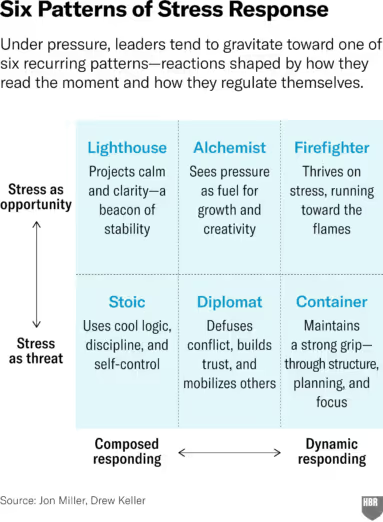
Our goal here was not to create a scientific taxonomy but to help leaders understand how they operate under duress and make better decisions when it matters most. In this article we’ll take a closer look at the six patterns—how they show up in moments of strain, what strengths they offer, and where each can go wrong under sustained pressure.
The Lighthouse
Lighthouse leaders project calm when others are rattled. In a crisis they maintain a measured pace, regulating their breathing, lowering their voices, and staying focused on the horizon—not just on the crisis immediately in front of them. Stress triggers their orientation toward stability over speed, and their first rapid appraisal of a new situation is more likely to recognize opportunities than threats. Instead of matching urgency with urgency, they tend to hold their ground and steadily guide others through ambiguity.
In high-pressure situations this style of leadership creates conditions that promote psychological safety, where people feel free to speak up, admit mistakes, and express uncertainty without fear of humiliation or punishment. Studies of high-reliability organizations—from air-traffic control to hospital emergency units—show that calm leadership keeps teams focused and prevents what psychologists call the “emotional contagion of fear.”
Several years ago we worked alongside the leadership of a consumer goods company when a politically charged boycott erupted over its stance on a divisive issue and was amplified by a social media campaign. The CEO responded like a lighthouse, acknowledging the potential damage—the share price had taken a hit—but reinforcing that the company had taken that stance because of its underlying values. Behind the scenes the board expected the CEO to make a rapid reversal, but she resisted. Some criticized her calm response as sounding tone-deaf, but it reassured most stakeholders, and the storm passed.
As this story shows, lighthouse leaders face hidden risks. This CEO’s composure appeared to some to be aloofness. And teams sometimes interpret lighthouse leaders’ silence on seemingly critical issues as indecision. In prolonged periods of stress, their drive for stability can harden into inertia; they may fail to face up to bad news, lack the appropriate urgency, or quietly take on too much themselves. One senior executive at a global retailer captured this tension perfectly: “I thought my job was to be the calm center. But my team later told me it felt like I wasn’t letting them in.”
Adaptive strategies for lighthouses: During a crisis the first step these leaders should take is to explain their intentions. For example, they could tell their teams: “I’m staying calm so that we can think clearly,” not “I’m calm because everything’s fine.” Next they should invite their teams to share their emotions and should reciprocate in kind. They might ask how others are coping, which will legitimize the stress people are feeling rather than suppress it, reinforcing psychological safety. Finally, they must signal momentum. Even calm leaders need visible microactions—small decisions, next steps—to reassure others that their stability isn’t masking inertia or indecision.
The Alchemist
Alchemists see pressure not as a threat but as a catalyst for growth. In a world defined by overlapping disruptions, they treat turbulence as the raw material for reinvention—a signal that the old logic no longer fits. Alchemists’ responses are a combination of composed and dynamic: Outwardly they’re steady, but inwardly they’re kinetic. They think in ways that help them connect dots others don’t yet see. Under duress, they look for possibility, not predictability. They’re the kind of leaders who hear, “The playbook doesn’t work anymore” and reply, “Great—then we get to write a new one.”
Alchemists gravitate toward frontier spaces where disruption and opportunity meet—like AI, climate tech, and fields where global trade and talent patterns are changing. Netflix cofounder Reed Hastings captured the alchemist’s blend of realism and optimism when he said: “Be brutally honest about the short term…and optimistic and confident about the long term.”
A few years ago we worked with a company that was thrown into turmoil when a whistleblower revealed that data on its discharge of industrial wastewater had been systematically falsified. The news triggered threats of litigation and undermined the company’s integrity. When it broke, the CEO responded like an alchemist, launching an ambitious program of structural and cultural reform, overhauling incentives, and simplifying reporting layers. He seemed to relish the opportunity to break from the company’s past narrative. Although its external stakeholders responded well, behind the scenes many parts of the organization were unsettled by the pace and scale of the transformation.
This example illustrates the power and risks of the alchemist style. Under prolonged uncertainty, alchemists can slip from creative to chaotic, chasing novelty for its own sake or exhausting teams with constant pivots.
Adaptive strategies for alchemists: Under pressure alchemist leaders should fix on a North Star. They need to know why they’re making a transformation—“because we can” isn’t enough—and define what problem the change is meant to solve. And instead of running back-to-back transformations that leave teams perpetually in motion, they should establish a regular cadence for change: cycles of push and pause, invention and consolidation. Finally, they must moderate their tendency toward reinvention and creativity by collaborating with pragmatic teams that can organize and execute transformations skillfully.
The Firefighter
Firefighters thrive on pressure and momentum. They favor decisiveness over prolonged analysis. When a crisis erupts, they move fast, radiate urgency, and mobilize others. They not only respond to stress very dynamically but tend to see it as an opportunity. Pressure doesn’t paralyze them; it ignites them. Often fueled by adrenaline, they restore a sense of empowerment when others freeze. In the short term this energy can be invaluable: Momentum builds, decisions get made, and complexity feels manageable.
Where the alchemist uses stress to spark creativity and explore new possibilities, the firefighter uses it to spur immediate action. The alchemist asks, What could this make possible? The firefighter asks, What must we do right now? Both convert pressure into energy, but one channels it into experimentation, the other into execution.
Firefighters embody in extremis leadership—a term coined by researchers at the West Point military academy to describe decision-making amid threats, urgency, and uncertainty. Research on “action bias” helps explain their appeal: Action itself reassures both the leader and the team that progress is underway. As the organizational theorist Karl Weick, who popularized the story of some soldiers who got lost in the Alps and found their way back to camp using a map of the Pyrenees, noted, “When you are lost, any old map will do.”
However, under prolonged strain, a firefighter’s immediacy can become problematic. Every spark starts to look like a blaze, and decisions can become impulsive. As one former COO reflected, “You feel most alive when you’re fighting fires, but you have to be careful you don’t start fanning the flames.”
We saw this play out while working with a company whose production line stalled because its supply of chips fell dramatically when a severe drought hit a critical semiconductor-manufacturing region. It was impressive to watch the firefighter CEO swing into action, setting up a global command structure, authorizing aggressive procurement, green-lighting rapid redesigns, and chartering aircraft to fetch scarce components. It also worked: The company resumed partial production far faster than its competitors did, but the speed of decision-making outpaced cost controls. And we also saw a hidden cost: Teams struggled as priorities shifted weekly, and burnout spiked among employees across operations.
When balanced, the firefighter embodies the best of decisive leadership: courage, momentum, the will to act when others hesitate. However, great leadership is measured not only by the flames extinguished but by what is preserved and the future fires prevented.
Adaptive strategies for firefighters: In a crisis the first step firefighter leaders should take is to pause before acting—to get set, then go. A short break will give them a chance to regulate their nervous systems and clarify their intent to their teams. Next they should involve others in decisions early on. That will distribute the cognitive load in a way that will help them sustain their energy over time and prevent burnout. Finally, they should hold quick after-action reviews on a situation once the immediate urgency has passed, asking: What worked? What didn’t? What felt productive but actually wasn’t? Such reflection can turn the adrenaline spikes into learning and help release the stress people have been carrying.
The Stoic
Stoics lead through discipline and self-control. When the pressure spikes, they get analytical—anchoring themselves in principles and reason and striving to create stability. They have a composed response to stress, sharing the lighthouse’s external calm but for different reasons: While the lighthouse uses steadiness to create space and perspective, the stoic uses it to manage internal volatility. The lighthouse, regarding stress as an opportunity, looks outward, scanning the horizon; the stoic perceives stress as a threat and looks inward, tightening focus and minimizing emotional reactions. This mindset can often be traced to early professional training—for instance, as an engineer, a lawyer, or a military officer. The result is a distinctive style under pressure: calm, deliberate, and rational to the core.
This orientation has real strengths. When a crisis hits, stoics naturally slow down, regulate their emotions, and reintroduce order. Behavioral research shows that this approach supports clearer reasoning under uncertainty. The stoic’s discipline can therefore preserve strategic coherence when others are spiraling. General Motors CEO Mary Barra captured this ethos when she told The New York Times, “I don’t focus on what you can’t control.”
Consider a stoic we once counseled. Days before his company’s shareholders were due to vote on a major acquisition, a deepfake voice recording surfaced, seeming to be the CFO admitting to large, hidden off-balance-sheet liabilities. As that disinformation spread, the deal was thrown into doubt. The stoic CEO told his teams to ignore the noise and speculation and focus on establishing the facts. He surprised the market by halting the vote and commissioning independent forensic audio experts to evaluate the recording. It was a nail-biting time. It looked as if the delay might kill the deal, and the CEO was criticized by many—but the voice on the recording was proved to be synthetic, and the acquisition eventually went through.
Treating emotion as a distraction may lead stoics to withdraw just when human connection is most vital, however. Their desire to stay rational can push them deeper into data and process, producing technically accurate but emotionally clueless decisions. And the costs are often internal: Unexpressed stress can cause insomnia, fatigue, or quiet burnout.
For stoics, the developmental challenge is ensuring that their steadiness remains advantageous—a source of clarity, not a defensive shield that closes them off from insight or support.
Adaptive strategies for stoics: In a crisis, stoic leaders must first regulate themselves—steadying their own emotional responses without suppressing them. Then they can make the emotional climate open to discussion, articulating what the tension in the room may be signaling: “I sense frustration building; let’s explore why.” Next they should visibly practice empathy. Briefly voicing shared difficulty (“I find this decision tough, too”) can strengthen trust without surrendering authority. Finally, they should acknowledge their own emotions. That often means having a conversation about the pressures they’re facing with a trusted adviser such as a coach or a peer, turning stress into a source of insight rather than a silent load.
The Diplomat
Diplomats lead with tact. They ease tension through dialogue and keep teams connected when stress threatens to divide them. For these leaders, a crisis is as much a social test as a strategic one. Under pressure they foster social connection—defusing conflict, sustaining trust, and reading interpersonal signals as carefully as others read financial data.
Diplomats respond to stress in a manner that’s composed but dynamically attuned to relationships. Under strain, their social intelligence helps them hold together teams that might otherwise fracture. Diplomats sense tension before it surfaces and soften it by enabling what psychologists call relational regulation—which happens when connection helps people manage emotions. Emma Walmsley, who led the biopharmaceutical firm GSK through a difficult period of industry change, sounded like a diplomat when she said to Fortune, “It’s not about being a superhero…It’s about the team, it’s about the company.”
A few years ago investigative journalists uncovered forced labor deep within the extended supply chain of a company we worked with, triggering NGO campaigns against it and possible retailer defections. When the story broke, the CEO responded in the classic style of a diplomat: She avoided a defensive response and instead acknowledged the company’s role in the ecosystem, moving quickly to engage stakeholders and commission independent audits. This swift, conciliatory posture took the heat out of the situation—although internally, some in the management team felt that relationship repair had been given precedence over legal risk.
Indeed, under sustained stress, diplomats may tilt toward consensus over candor—smoothing over conflict rather than addressing it directly. Their composure can become caution, and their diplomacy can slide into delay. As one executive who identified with this pattern admitted, “Sometimes I’d rather have a slightly wrong decision everyone supports than the right one that divides the team.”
Adaptive strategies for diplomats: At their best, diplomats aren’t conflict-avoidant but understand that rupture and repair are healthy for relationships. Their first step in a crisis is to surface the tensions. That means saying plainly what others sense but won’t voice, naming the discomfort in a way that clears the air and creates space for honesty without blame.
One practical way to do that is to build dissent into a company’s crisis management process—through debate, premortems, or red-team exercises (in which an internal team plays the role of devil’s advocate)—so that disagreements are brought to light in a structured way. Finally, diplomats need to be clear about where they stand. Their empathy helps others regulate themselves, but in times of stress people also need well-defined objectives and direction—to experience the safety and reassurance that come from knowing what the leader is guiding them toward and what happens next.
The Container
Containers lead with control. They respond to stress by imposing structure and holding the system together when others are overwhelmed. They excel at managing multiple demands coherently. Like firefighters, they respond to stress dynamically, but they see it as a threat, and their instinct under pressure is to convert ambiguity into clear priorities and channel energy into disciplined execution. They often rely on a tight inner circle—a small, trusted team they can move decisively with while filtering out noise.
Containers’ mindset is captured in the mantras we’ve heard many of them repeat: “strong and steady,” “left foot, right foot,” “you can’t outrun a storm.” Intel cofounder Andrew Grove’s famous line “Only the paranoid survive” captures the container’s vigilance.
When one company’s internal networks were frozen by sophisticated ransomware attackers, we witnessed a classic container response from its CEO. A big risk in this moment was panic: Alongside the urgent need to restore the systems, the situation triggered immediate simultaneous obligations to regulators, insurers, and customers—which threatened to overwhelm decision-making. The CEO imposed clear crisis structures with tightly defined decision rights and a highly controlled information flow. This military-level discipline succeeded in preventing confusion while a recovery was engineered, but behind the scenes parts of the organization were left anxious and disoriented because the response happened behind closed doors.
This example shows how containers can be invaluable in a crisis. But their intense focus may exclude voices outside the inner circle, leaving teams feeling shut out or underinformed. When the pressure builds, the container can absorb too much of it, too quietly.
Adaptive strategies for containers: The challenge for containers is learning that sustained performance depends not just on endurance but on knowing when to release pressure, widen the lens, and let others help carry the load. Their first step in a crisis should be to deliberately blow off pressure—to use reflection, feedback, and recovery to allow themselves to reset. They should also routinely zoom out, engineering systematic, regular shifts in perspective on their teams so that their organizations aren’t operating with tunnel vision. Finally, they need to model resilience. None of us is indestructible, and teams take their cues from the top. So leaders should visibly make rest and renewal part of performing well under pressure.
From High Pressure to High Performance
Crises rarely announce themselves with clarity. They arrive quickly and demand that leaders interpret incomplete information under heightened strain. In these moments stress-response patterns shape what leaders notice, how quickly they move, and where their blind spots may lie. Preparing for high-stakes decisions therefore requires a good process, including an understanding of how you’re likely to react when pressure peaks, based on your default response type. (To identify yours, go to our survey at stressintelligence.org/test.) Here are some examples of how default responses can differ:
An activist investor targets a company’s leadership at an underperforming corporation. Lighthouse leaders may treat the scrutiny as clarifying, engaging shareholders with a structured, transparent review; container leaders, on the other hand, may convene a war room, refining a comprehensive end-to-end response before making a single definitive revelation.
A major cybersecurity breach exposes customer data. An alchemist may use the shock as an impetus to push through a modernization program, while the first instinct of a diplomat may be to engage the media, regulators, and customers to restore trust and confidence.
A fresh geopolitical rupture—such as new sanctions, export controls, or a market shutdown—hits key geographies. A firefighter leader will move immediately, rerouting operations and signaling decisive action; a stoic, by contrast, will hold steady, monitoring signals until the strategic path becomes clear and then executing with precision.
There are no intrinsic rights and wrongs here. Each of these responses has its strengths and weaknesses. Leaders who consistently turn pressure into performance don’t get stuck in a single default response style; they treat leadership under stress as something that can be practiced and refined—experimenting with different styles, sensing how the situation is evolving, and recalibrating as they go. We can break this down into a few clear steps:
Expand your range of responses. Deeper awareness of how response patterns typically play out will help both individual leaders and teams recognize more choices. To develop it, consider creating a brief playbook of responses or an AI decision-support agent that tracks your response style and suggests alternatives. During crisis simulations or even real events, you can deliberately try on a style that’s not your default. If you’re naturally a stoic, experiment with a firefighter-like surge of decisive action; if you’re a firefighter, challenge yourself to pause for a lighthouse-like scan of the horizon before moving. Over time this deliberate cross-training will make it easier to shift between types as conditions change and to avoid the pitfalls of your default response.
Test and adjust in real time. High-stakes situations aren’t static—they can shift rapidly and dramatically. Refining your response style over time may be critical, and it’s important to ask, Is my approach still working? The “fallacy of uniform efficacy”—the belief that what worked once (staying calm, acting fast, pushing through) will work every time—can be quite dangerous. The seasoned leaders we spoke with instinctively test and adjust their style in a continual-feedback loop. Asking simple questions will help: Is this response reducing or amplifying confusion? Is it moving us closer to our objectives or just making us feel busy? What is my team experiencing from me? Over time this approach will allow you to adjust your internal compass for which response type to lean in to and when.
Develop flexibility. Because each response type offers distinct strengths, the real potential gains come from selectively harnessing them to meet the demands of the situation. Here are some examples:
The stoic approach allows leaders to concentrate on what’s within their influence and let go of what isn’t. Focusing on the things they can actually change—priorities, behaviors, decisions, cadence—creates clarity and reduces wasted effort.
The container approach shows leaders how tight information flows and clear decision rights can help them weather a storm. They can also use the container’s adaptive strategies to interrupt the escalation cycle—in which pressure compounds because you’re fighting it rather than acknowledging it—before it damages performance.
The lighthouse approach enables leaders to stay grounded and keep the full horizon in view. It isn’t about muting urgency but about placing it in context so that the organization stays focused on what matters most.
The diplomat approach can help leaders recognize that calm travels quickly—and so does tension. Teams pick up a leader’s microsignals, and unmanaged stress erodes trust. Regulating emotion becomes part of protecting relationships and maintaining cohesion.
The alchemist approach allows leaders to leverage a different kind of stress—not the spiraling kind but a focused tension that sharpens the imagination and pushes people toward breakthrough insights. Pressure helps alchemists rethink the problem and spot options they’d miss if they stayed in “business as usual” mode.
The firefighter approach lets leaders channel urgency into mission. Purpose gives adrenaline direction, creating coherence and sustaining performance long after the initial surge fades.
Share the cognitive load. Leaders should not feel they have to shoulder a crisis alone. Some of their cognitive load can be borne by systems and by their colleagues. At an organizational level, that means establishing clear decision frameworks, values, and escalation paths before crises hit so that teams know how to behave under pressure. It means consciously designing leadership teams with a balance of response types—not just a room full of firefighters or stoics—and normalizing the open discussion of stress in executive forums. At a personal level, it means building a trusted group of peers, mentors, advisers, and perhaps a coach or therapist who can help you interpret stressors, challenge your default responses, and widen your options.
. . .
As leaders experience rising pressure, those who excel will be distinguished not by immunity to stress but by mastery of their reaction to it. By becoming a student of your own patterns—and expanding the range of responses you can call upon—you can strengthen your resilience in times of duress. In the end, leading well under pressure is less about holding firm to one style and more about knowing when to shift. That adaptability is what turns a crisis into clarity and strain into strength.
Copyright 2026 Harvard Business School Publishing Corporation. Distributed by The New York Times Syndicate.
Topics
Self-Awareness
Resilience
Self-Control
Related
Filling the Cracks with GoldResigned to Resignation: When Asked to Step Down as a Medical School DeanLeadership is a Journey and Not a DestinationRecommended Reading
Self-Management
Filling the Cracks with Gold
Self-Management
Leadership is a Journey and Not a Destination
Self-Management
Don’t Quit Your Job Before Asking Yourself These Questions
Self-Management
Addressing Sexual Misconduct in Healthcare